
Gerrit Meiners, Research Assistant – E-mail / Instagram
Integrated Environmental Solutions (INES)
Indian Ocean Exploration Project (INDEX)
Website: https://ines-solutions.eu
Moin, moin together!
Imagine trying to understand the complexity of a dense rainforest, but you’re only allowed to look at it through a window from a plane flying miles overhead. For a long time, that’s pretty much how we had to study the deep ocean floor.

My name is Gerrit Meiners. I’m a marine ecologist from northern Germany, and my “office” spans the Indian Ocean Ridge—an enormous underwater mountain chain home to fascinating ecosystems like hydrothermal “black smoker” vents. As a research assistant at Integrated Environmental Solutions, I work with the INDEX project (managed by the Federal Institute for Geosciences and Natural Resources on behalf of the Federal Ministry for Economic Affairs and Energy) to explore these remote seafloor habitats and help establish vital environmental safeguards.
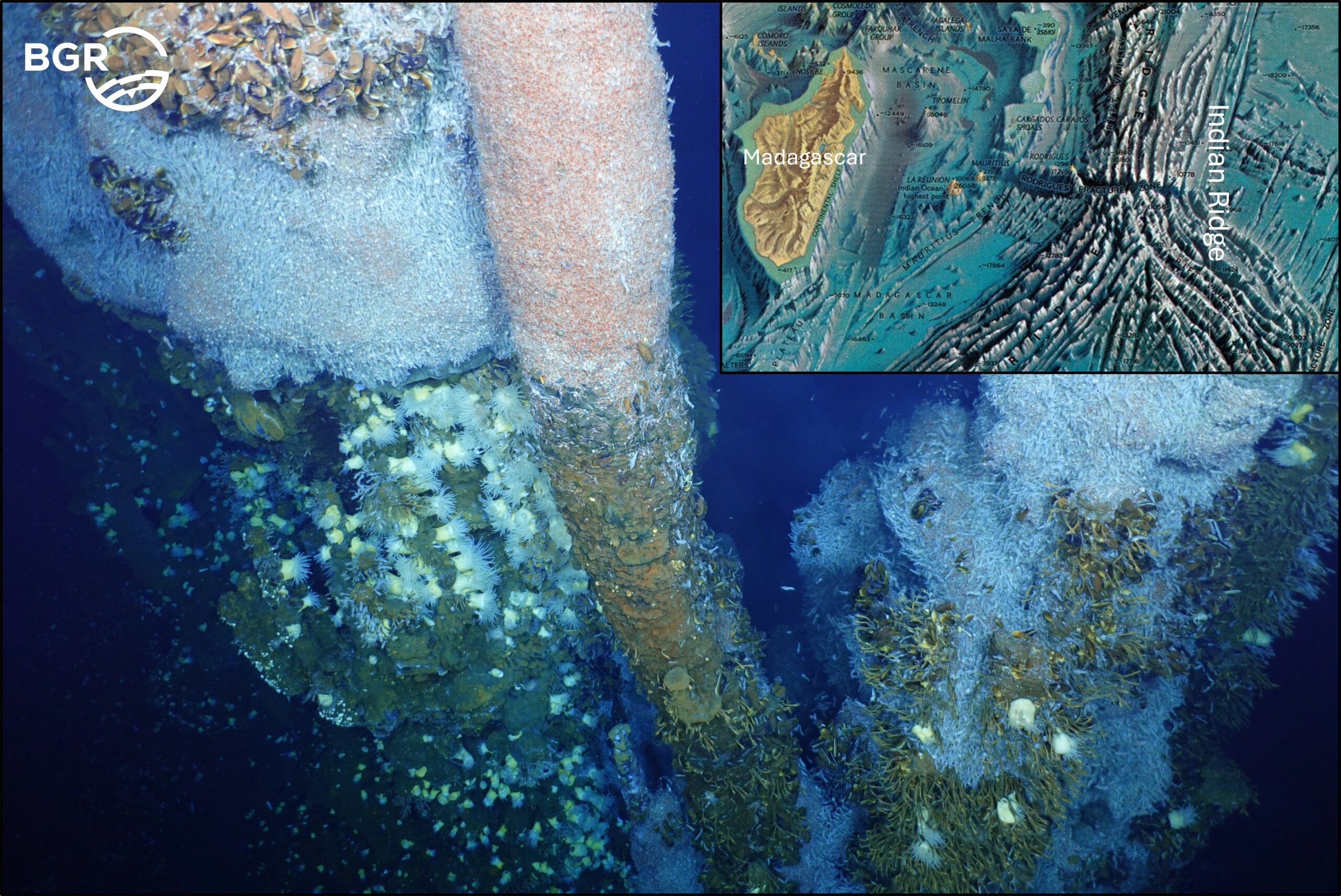
My research focuses on deep-sea megafauna—animals larger than a centimeter—and how they navigate these complex, rugged underwater terrains. Traditionally, broad maps of the seafloor only show us large-scale dynamics at a coarse resolution, which is like observing a forest canopy from a plane. On the other hand, standard underwater video only gives us a narrow, “flashlight” view of a single spot at a time.
To bridge this gap, we use a 3D modeling technique called Structure from Motion Photogrammetry. By stitching together hours of exploratory video footage captured by underwater robots, we can reconstruct digital, centimeter-scale replicas of entire dive sites. This technology finally allows us to step out of the plane, connect the dots, and explore the landscape “on foot,” giving us an unprecedented look at exactly how deep-sea animals interact with their habitat.
Thanks to a research award from the Deep-Sea Biology Society, I was recently able to take this perspective to the German-American Nature-Based Solutions Exchange (GANBASE) organized by POCACITO.
Discussions about “nature-based solutions” to climate change usually stop at the coastline, focusing on mangroves or forests. But the deep sea is the ultimate climate regulator, absorbing over 90% of excess heat and 30% of our carbon emissions. Yet, we are only just beginning to understand how this hidden world works. Presenting to a diverse group of scientists, engineers, and policymakers, my message was clear: because the deep sea is vast and recovers slowly, protection must take precedence over restoration. Preserving the integrity of the deep ocean is one of the most critical, nature-based contributions to stabilizing our climate.

If you are interested and want to know more, check out my contact details at the top of the page and feel free to get in touch!
