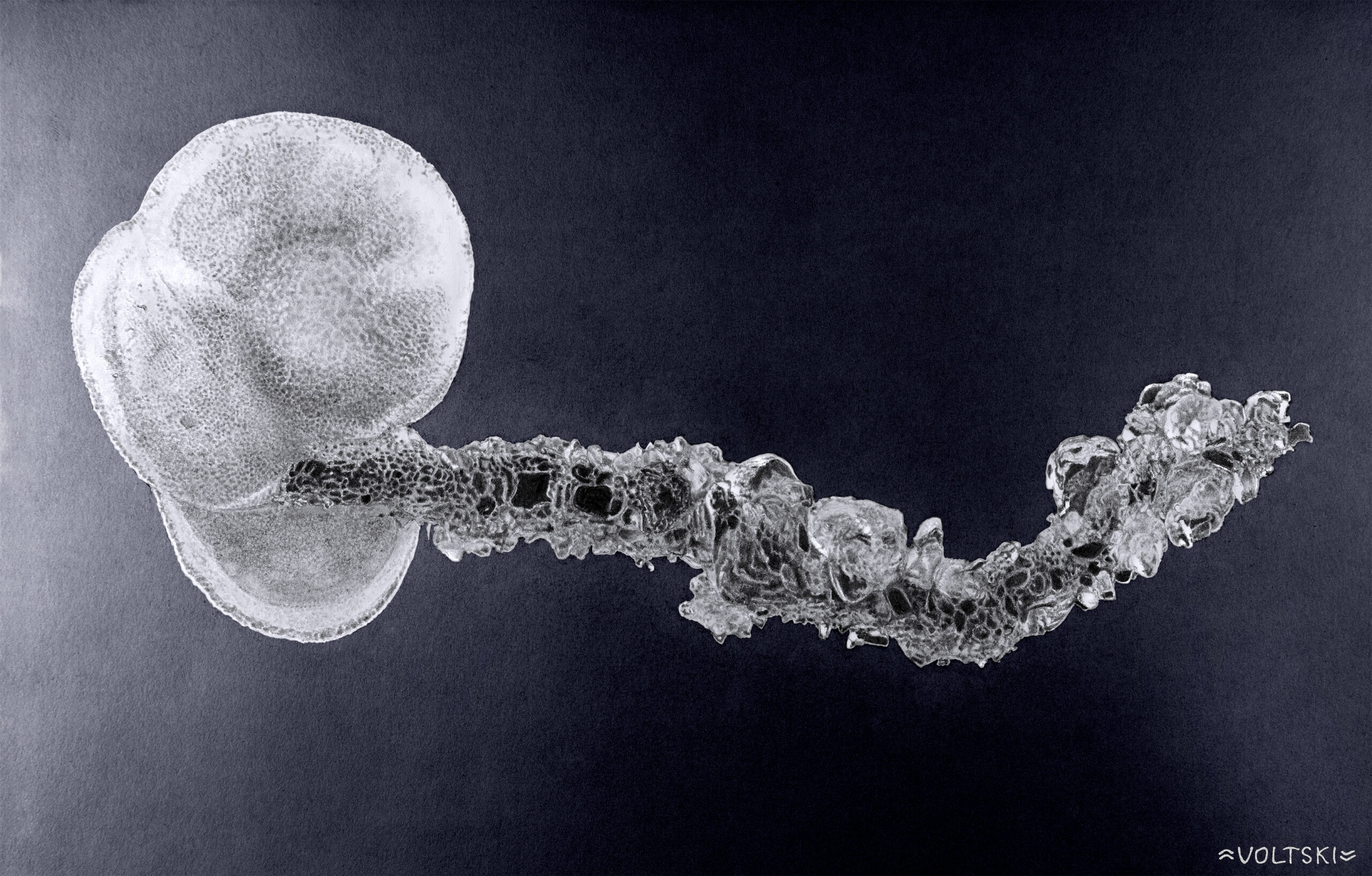
𝑅ℎ𝑖𝑧𝑎𝑚𝑚𝑖𝑛𝑎 is a globally distributed genus of xenophyophores (Foraminifera, Monothalamea) commonly found on soft sediments in abyssal areas. It looks like a maze of dichotomously branching tubes with walls consisting of mineral grains & shells of other foraminifera. Tube lumens are filled with cytoplasmic strands and dark masses of stercomata (waste pellets). Irregular lumps of such tubes are sometimes observed on the surface of freshly recovered sediment samples. The illustrated specimen is a short fragment of 𝑅ℎ𝑖𝑧𝑎𝑚𝑚𝑖𝑛𝑎 (~1.9 mm long), with an empty shell of a planktonic foram (𝐺𝑙𝑜𝑏𝑜𝑟𝑜𝑡𝑎𝑙𝑖𝑎 sp.) still attached at one end; originally, it was collected with a multiple corer at 5498 m depth, photographed, and preserved for DNA analysis.
Many outstanding questions regarding these remarkable xenophyophores remain:
- 𝑅. 𝑎𝑙𝑔𝑎𝑒𝑓𝑜𝑟𝑚𝑖𝑠 a globally distributed species, like some other deep-sea foraminifera, or there are many related species with blurred morphological boundaries?
- Aspects of its benthic lifestyle: growth dynamics, position with respect to the sediment surface (does it produce an anchor or ‘roots’? is it able to somehow orient itself with respect to the sediment surface?) and its feeding strategy are not exactly known.
- Cytology of 𝑅ℎ𝑖𝑧𝑎𝑚𝑚𝑖𝑛𝑎 is not fully explored; the only dedicated study involving electron microscopy was published a while ago (Cartwright et al. 1989).