
Eve Caroline Southward (née Judges)
1930-2023
It is with great sadness that I have to report the passing of my friend and colleague Eve Caroline Southward in January, at the age of 92, following a stroke in December.
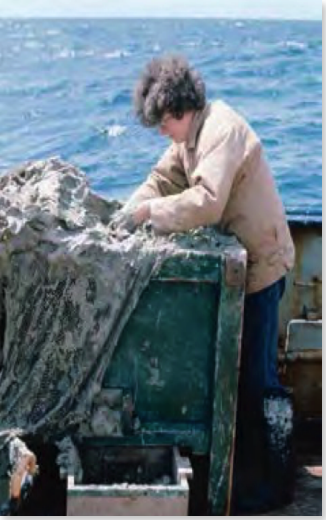
Eve was brought up in Kew Green and Chiswick, London and recalls mud-larking on the Thames (an activity continuing in later years, Fig. 1) and frequent visits to the Natural History Museum and Kew Gardens, developing a life-long interest in identifying plants. This was re-enforced when her school, Froebels, was evacuated to a country house NW of London during the war. This countryside environment exposed her to more ‘natural history’. Eve considered studying agriculture or horticulture, when a neighbour, a professor at Liverpool University, suggested she studied Zoology there, specialising in Marine Biology. After reading C.M. Yonge’s “The Sea Shore”, Eve thought it sounded interesting and applied.
All zoology students took field courses at the Port Erin Marine Laboratory on the Isle of Man. When Eve graduated, as the only Marine Biology student in her year, she was offered a post-graduate studentship and studied the ecology and distribution of the Polychaeta of the Isle of Man, achieving her Ph.D. in 1955. Eve married a fellow student, Alan Southward in 1954. In 1956, when Alan was appointed to a post at the Marine Biological Association of the U.K., Eve moved with him to Plymouth. An opportune timing for starting deep-sea studies, since the MBA had recently acquired a 39 m research vessel, ‘Sarsia’, with 3000 m of dredge wire. Alan and Eve made use of ‘Sarsia’ and started dredge-sampling for benthos on the continental slope in 1957. They found frenulate siboglinids in the Atlantic for the first time. These mouth-less and gutless tubeworms fascinated Eve, who carefully described new species and their morphology, using both light and electron microscopy.
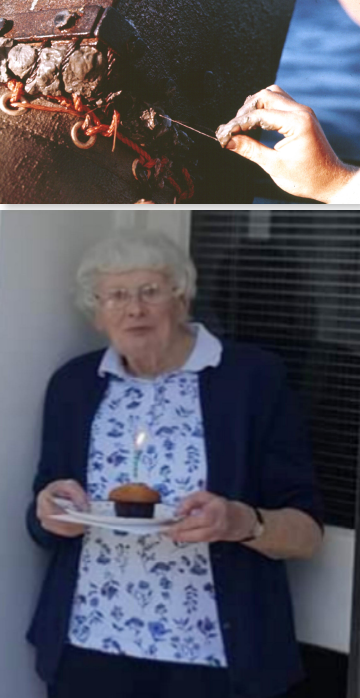
Above: Eve, celebrating her birthday during Covid isolation. (Photo, Dorothea Orme, 2021)
For the next two decades Eve and Alan worked on the problem of how frenulates fed, initially working on the theory that they took up dissolved organic compounds from the interstitial water, possibly using excreted digestive enzymes. Following the discovery of clumps of large vestimentiferan siboglinids on the Galapagos Spreading Centre in 1977, Colleen Cavanaugh found that these contained sulphur-oxidising endosymbiotic bacteria and suggested to Eve that this might apply also to the frenulates. Eve examined her specimens and found high densities of bacteria in the post-annular region. Enzyme studies proved that they were indeed sulphur oxidisers. However, the problem of the energy source, since significant dissolved sulphide could not be detected. Eve first noticed an oxidized zone in the sediment adjacent to the frenulate tubes. It took her another 15 years along with detailed dissection of box cores, tracing the path of the tubes and micro-scale geochemical sampling to show that oxygen diffusion through the tube wall, leading to mobilisation of solid-phase sediment sulphides was the likely energy uptake route.
In the late 1980’s Eve started collaborations with Verena Tunnicliffe, making summer visits to Victoria, B.C., describing hydrothermal vent fauna, their nutrition and reproduction. In addition Eve made significant contributions to research on bivalves with chemoautotrophic symbiotic bacteria from both deepsea and shallow water environments.
Eve was asked in her late 70’s if she had plans to retire. Her response was that “scientists never retire, they just expire”. True to this, Eve published her last scientific paper in 2021 and wrote a last article, for the April 2023 issue of the ”Marine Biologist”, just before her death. Appropriately, for someone who loved plants and raised Camellias from seed, a single white flower of Camellia ‘Winter’s Snowman’ was open, in her walled garden, on the morning of her death.
Paul R. Dando
pdando@mba.ac.uk
From DSL20
