
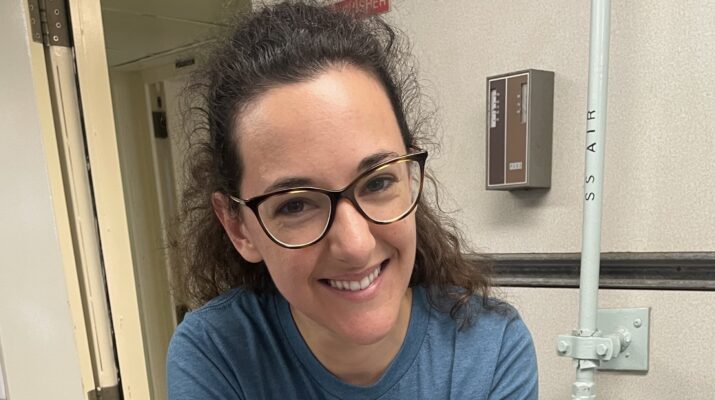
Melissa J. Betters, PhD (she/her)
Ph.D. Biology, Temple University
B.S. Biological Sciences, Florida State Univ
Contact: melissa.betters [ a.t ] temple.edu
What has been your personal journey into the deep-sea? (Did you always know this is what you wanted to do, or start out on a completely different path?) In other words, what unique journey led you to where you are now?
I always say that everyone, at some point, has wanted to be a marine biologist… I simply never stopped! I knew that I wanted to study marine biology when I started my undergraduate degree at Florida State University. However, I didn’t have my first experience with deep-sea research until my senior year. When one of my professors, Amy Baco-Taylor, learned that I was interested in deep-sea research, she generously invited me on a research cruise for the autumn after my graduation. I had no idea at the time that this cruise would be a 60-day stint out at sea, nor that I would dive nine (yes, nine!) times down to the bottom of the ocean. Not only was this cruise one of the best experiences in my life, but it was also exactly what I needed to stand out when applying to graduate school. I would go on to pursue a Ph.D. in deep-sea marine biology at Temple University that following year.
What is your current research question and why are you interested in this topic?
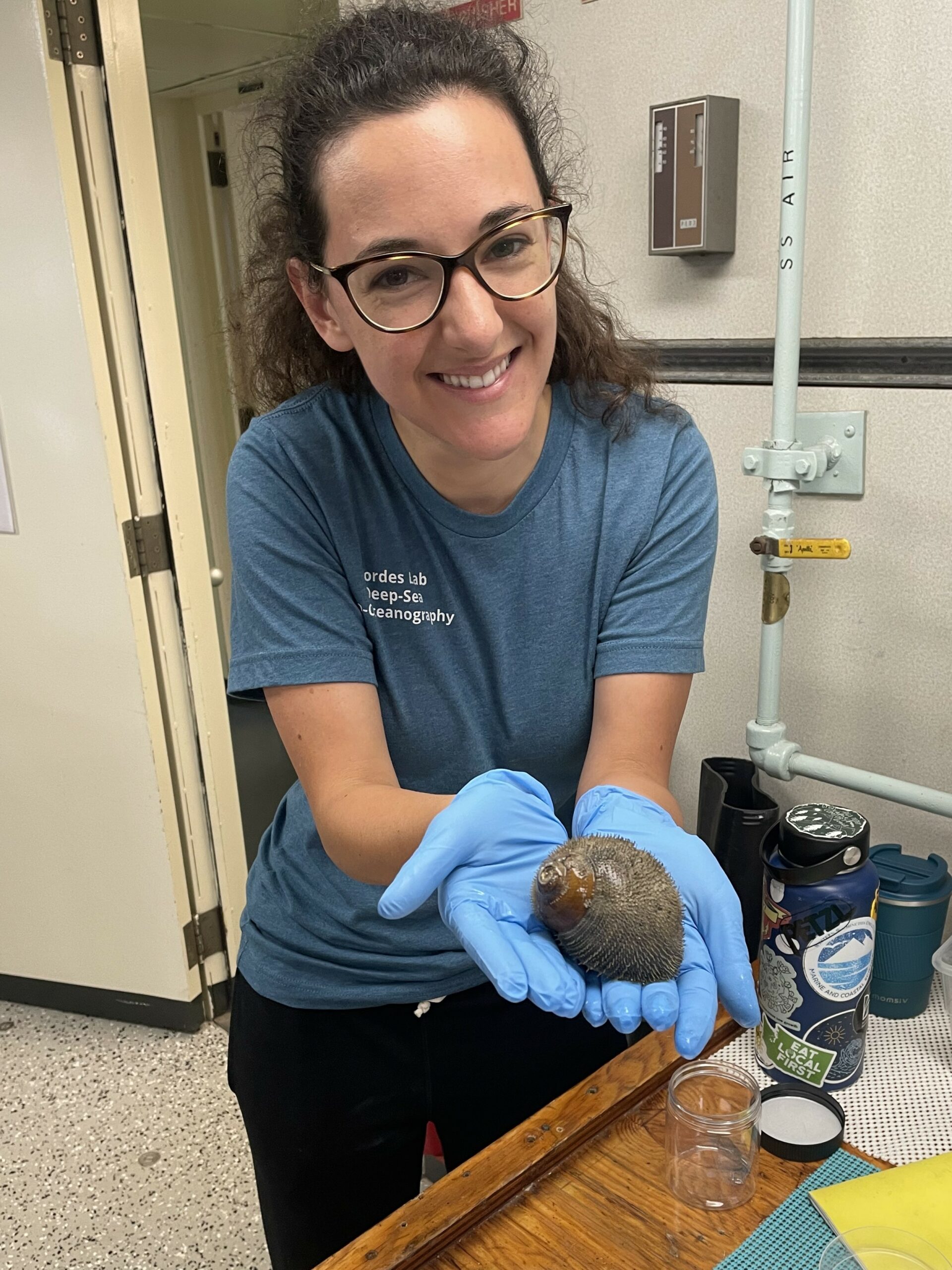
My main research interests lie in biogeography, evolutionary reconstruction, and taxonomy. My current research question focuses on how animals at chemosynthesis-based ecosystems, like hydrocarbon seeps and hydrothermal vents, have diversified across global regions and environments. Specifically, I work with deep-sea gastropods (snails and limpets) which occur in huge numbers within these ecosystems. I am
currently pursuing aspects of this research at the Smithsonian Museum of Natural History (starting in Fall 2024).
What have been some challenges in your work or in studying the deep sea in general? Has your research turned out how you expected?
For one, I never expected to be a snail expert! However, given the questions I’m interested in and the abundance and global distribution of these little guys, they are the perfect specimens to work with. The main challenge that arose during my research was the difficulty in identifying species! To answer questions about a species’ biogeography and evolutionary history, what that species is must first be clear. There are very few species identification resources for the deep sea, and so this was much harder than expected! This challenge ultimately led me down the road of taxonomy, and I ended up describing four new species of limpets during my Ph.D. as a result.
Why is this work important to you and society as a whole?
I believe that studying the deep-sea, in general, is essential to crafting a holistic view of our planet. We cannot truly understand how our world functions without a thorough understanding of the deep ocean. As for my personal research, I believe that it is important to continue describing new species to better facilitate future research, to give an accurate picture of the deep sea’s biodiversity, to identify rare or endangered species, and to document our natural history for posterity.
What advice could you offer to aspiring deep-sea biologists?
Know what you’re getting yourself into! Do your research on this field and go into it with your eyes wide open. Talk to as many people as you can. I would also recommend that you explore all the various ways to get involved in deep-sea research outside of just biology! Marine technicians, sailors, engineers, computer scientists, mapping technicians/geographers, oceanographers, geologists, chemists, and science communicators all play vital and active roles in deep-sea research!
What is your favorite thing about the deep sea?
My favorite thing about the deep sea is that it holds such a place of fascination for humanity, whether someone has studied it for thirty years or not at all. I also love the chemosynthesis-based ecosystems I study! Descending more than a mile below the ocean’s surface to find thriving ecosystems bursting with color and life feels nothing short of a miracle.
Melissa received a Conference Support Award in 2023
